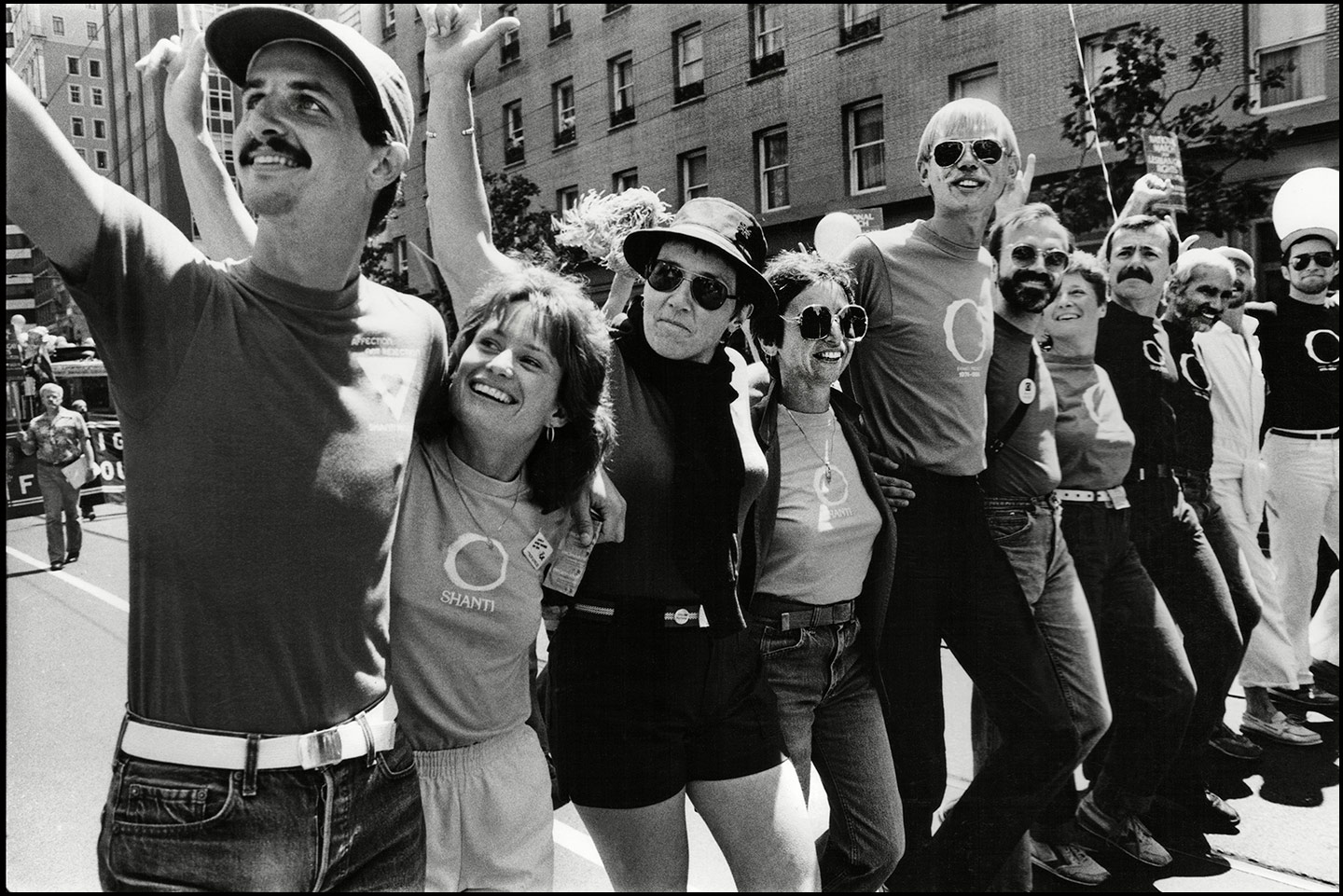
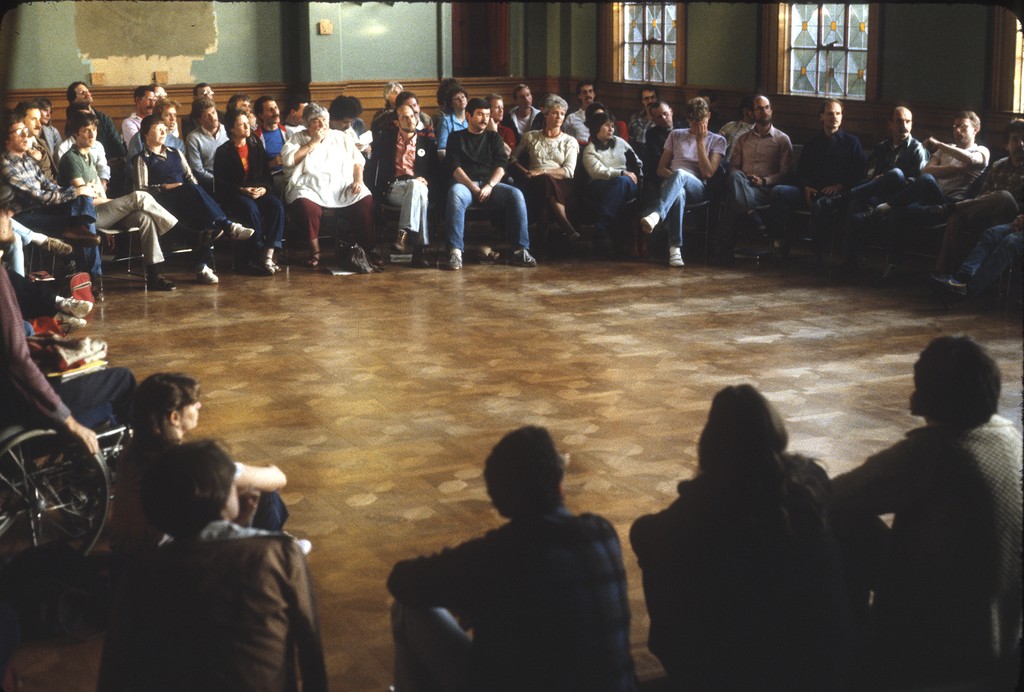
Shanti Training at the Pride Center, 1983
Shanti trainings would open with a larger group setting and would feature speakers and panels that would provide an in-depth “AIDS 101” course, which would also be included within their training manuals. Speakers would often be community members or health practitioners who were affiliated with Shanti. Very often people with AIDS (PWAs) would speak throughout the trainings. Shanti’s founder Charles Garfield would present about Shanti’s founding, working with dying people, and how to deal with stress and burn out. Outside of the educational portion of the training, volunteers would break into small groups lead by a facilitator that would meet and check in periodically throughout the training. The continued portion of the training would contain panels, roleplays/real plays, and experiential exercises. As the epidemic continued, in the mid 1980s Shanti would divide its trainings into specific ones for Practical Support volunteers and Emotional Support volunteers. Shanti’s trainings were as famous as the work itself. But, as the population of PWAs “changed” (i.e. non-gay white men) by the early 1990s Shanti’s services and training were reevaluated. This was controversial as Shanti began to lessen its attention to “emotional” specific work towards an expansion of direct services perspectives. While this was incredibly controversial for. Many longtime volunteers and staff, and created conflict within Shanti, that did not lessen the impact and importance of its training. Every person at Shanti, as it will become apparent throughout the exhibit felt that the training was a powerful experience.
“The fact that medical technology in the United States has taken off so rapidly and that medical schools have emphasized treating people, and curing them, and making them well again, [has] been nice in certain ways. But, unfortunately, by the wayside has gone some of the older things taught by physicians of hundreds of years ago when all of our modern equipment wasn’t available. Those kinds of things [that physicians taught] are just being there in [the patient’s] pain and suffering, the kind of things we’ve forgotten about in the face of our modern technologies…Most important is the human [relationship]…not so much the medical treatment. Patients, they need love and encouragement. It’s about living well not the dying process.”
– Steven G. Mehalko, MD, excerpt from his “Introduction to AIDS” portion of Shanti Training.
Mehalko was a key supporter of Shanti from the medical community, a founding member of Bay Area Physicians for Human Rights, as well as the Gay health collective at the Fenway Clinic in the ‘70s, 1950-1995. You can read Mehalko’s B.A.R. obituary here.
“I couldn’t make the [’82] training so the next training was a year later, July 1983. 33 years ago this month. And I went to the first night of the training…Back then it was a six day training…In the first time of my life I was in a room full of gay men and lesbians. There were 44 volunteers and there were probably 6 staff members and a dozen volunteers who were in the first training who were there to help. So, it was a circle of about sixty people. And I sat there, and I was absolutely terrified. I’d never been in a room full of so many gay men and lesbians. And I didn’t really know why I was there. I had seen the ad and I felt called; as kind of woo-woo as that sounds. I was called to go to this thing. And the first question they ask everyone was to talk about their hopes and fears. I was so nervous. I was so nervous.”
-Ed Wolf, Interview with Brendan McHugh, July 2016.
“The training served as a major turning point for me. I was so moved by the whole experience that I wanted to share it with others. During the training, I realized that even in what appeared be a hopeless situation, there was still hope for a better future…the potential for positive things to come out of this crisis, medically, socially, politically, as well as personal growth and love. I now believe that there will be some positive changes as a result of AIDS which will make the world a permanently better place. I have helped facilitate every training since July 1, 1985. I do these trainings in the hope that by sharing my experience with AIDS will help others. We are learning how to care for one another and that is a beautiful sight to witness. Not everyone can deal with a person that is sick, but if each one of us would do whatever we can towards dealing with the AIDS crisis, then I’m convinced it can be beaten.”
-Dave Lawson, Shanti client and activist living with AIDS, 1952-1989. You can read Dave’s BAR obituary here.
