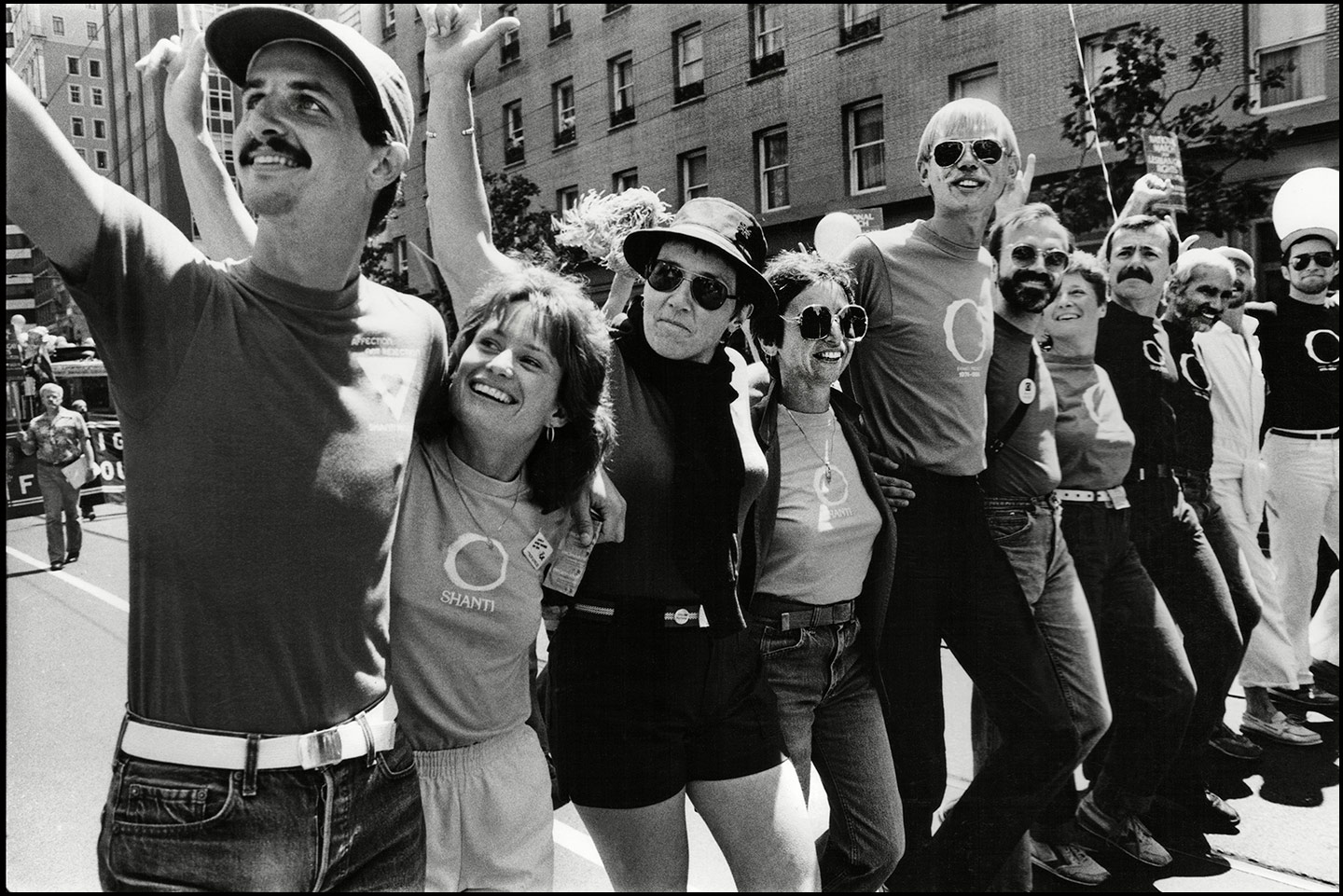
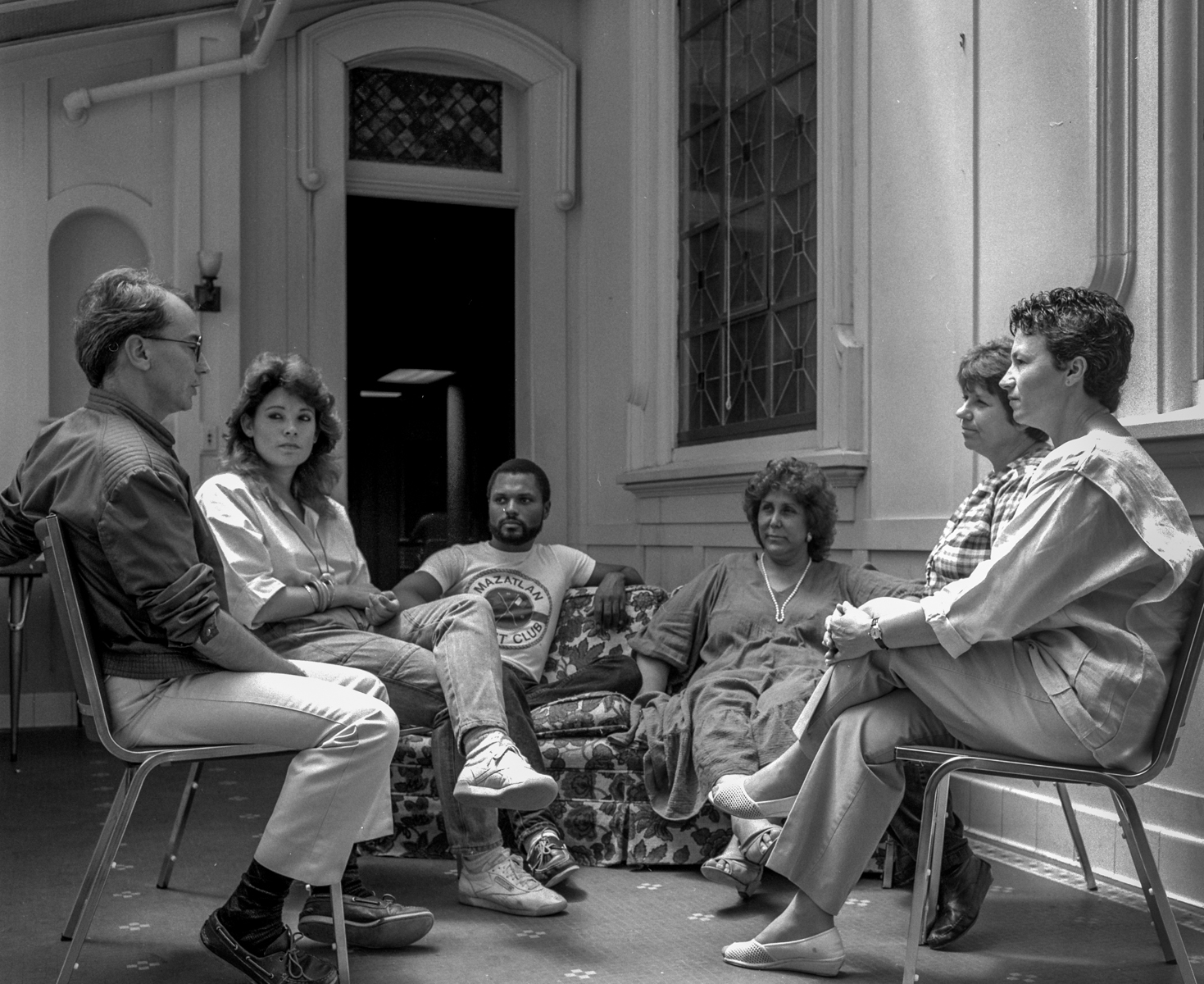
From right to left:
Unknown, Ginger Pappas, Alan Pughe, Marta Segovia Ashley, Unknown,and Rita Silverberg
Photograph by Judi Iranyi
A notable aspect about Shanti was its dedication to providing support for its volunteers and staff in the form of support groups. While Shanti’s support groups were most known for being there for people with AIDS/HIV or their loved ones a major component of its internal culture from the 1970s throughout the 1980s was assigning and organizing volunteers and staff support groups. Linda Maxey, who was the first manager of the Ward 5a Shanti counselors and started off as a Shanti volunteer, “I really believe in that model of Shanti, that you can’t do this for others if you don’t get support yourself. And so, once you finish training you have to be in a group, a support group.” Initially Shanti offered only one AIDS support group for clients in 1981, then referred to as a KS support group. It is probably one of the very first support groups offering services specifically to men living with HIV in the U.S. As Shanti solely began to serve PWAs and their loved ones the number of groups grew and focused on different aspects of HIV, such as couples counseling, support for volunteers, and off the record impromptu AA/NA meetings amongst the staff and volunteers. While the groups were an enormous part of Shanti’s draw, like any form of group therapy or peer support groups it was not always universally lauded by every single person who ever attended one. That being said, the drop-in groups at Shanti continued to evolve and still operate today.
“A typical group of ten might include two parents of two different people with AIDS, a sister of a man with AIDS living out of town, a brother of a man with AIDS living here in San Francisco, a woman whose best friend was diagnosed a year ago and who is the primary support for that friend, a man who has a friend recently diagnosed who is rejecting all contacts from his circle of friends, a man whose lover has been hanging on to life by a thread for six months, a man whose lover was recently at the point of death and now is enjoying a period of good health, and a man whose lover died seven months ago and who is back in the group again because his room-mate has recently been diagnosed.
Sometimes people ask us if it is really possible to have such a diverse group work. Our experiences is that the diversity is one of the things that makes the group most meaningful to everyone present..Just last night, someone said, “I don’t think you all realize how important it is for us gay men to have the women here. Many of us are isolated from our families. We don’t talk to our mothers and sisters.” It was good for all the women there to hear that they are valued.”
-Carol Tocher, “Support groups for Friends, Family & Lovers,” Eclipse: Shanti Project Newsletter, fall 1987.
“Almost two years ago my last client died. I was with him through his entire illness from diagnosis to death. We were very close. His last couple of months were very rough. I asked myself do I want to take a break? I heard that Shanti really needed group facilitators who could work during the day. Being a support group leader for people with AIDS has been a good switch for me. On the simplest level the work is an intense kind of listening and noticing how people are responding to each other. There is an unpredictability about it. It can be joyful and it can be devastating.”
-Daniel Bellm, “Emotional Support Volunteers Share Their Experiences,” Eclipse: Shanti Project Newsletter, October/November 1989
“Today was the second day of my Shanti Support Group…A new counselor named Andrew was there too…The opening “sharing” exercise is boring and repetitious and I am going to memorize and recite part of Lily Tomlin’s new play in order to liven things up a bit. I told Tony I loved him at one point. He is such a sweetheart with his big intelligent mind anchored to that wheelchair…At one point the leader asked Paul how he felt and Paul responded, “Just fine. Everything is great with me.” Tony looked at the rest of the group and said, “Let’s beat him up.”…The leader, Andrew, though personable and friendly enough, put me off by ‘overleading.’ He kept drawing lines and reeling people in when he felt they were going to dare suggest how someone else might live their lives…At one point, Andrew got tears in his eyes and told us all how deeply he felt for our pain and our predicaments. I was glad to hear it, but could not help thinking…I do not like feeling victimized. Having AIDS, you feel victimized when someone cries, not for you, but for your predicament.”
-Scott Humphries, (begrudging) Shanti client, excerpted from “Scott’s Diary” that was published in increments in the PWA Voice newsletter for the organization PWA/SF.
“We celebrated our first anniversary together this Valentine’s Day. Our first date was at a Shanti Valentine’s dance, first having met at a drop-in group for people with AIDS which was facilitated by Jim Geary. We both have AIDS and Kaposi Sarcoma. David was diagnosed two years ago and Ralph nearly three.
We went to Shanti for somewhat different reasons. David was having trouble with co-workers and wanted to find a support group that would treat him like a person, not a leper. Ralph wanted an opportunity to meet people with AIDS with whom to socialize without having to confront AIDS as an issue. The group worked. David got support and Ralph got David…Living well is the best revenge. We treat each other well and care for one another with love and understanding. Meeting at the Shanti group was an important start for mutual understanding. We had the special opportunity to meet in an honest and open environment, hearing one another’s concerns and participating in mutual support.”
-Ralph and David [not their real names], “Shanti Love Stories, Eclipse: Shanti Project Newsletter, 1986.
“I met J at my very first PWA support group meeting. Two things struck me about J: his face was covered with KS lesions and he had a radiant smile. I certainly didn’t feel radiant. I was depressed and frightened and freshly emerged from a hospital bout with pneumocystis. I spoke that day of acceptance. He spoke of refusing radiation and chemotherapy because he felt his health had become too precarious to withstand the shock. But, that was alright with J. He had come to accept that. And he spoke of the reactions other MUNI riders [San Francisco’s public transit] had to his lesions. He had come to accept that too, and said a remarkable thing: The more vulnerable I become, the more peace of mind I have.” I decided at once that I wanted what J had. It seemed that whatever came, he was prepared to receive it. I wanted that level of acceptance. I never saw J again. He died a few weeks later.”
-Hugh Krell, Shanti client, “Dancing in the Dark,” from PWA Update: Shanti’s PWA Newsletter
