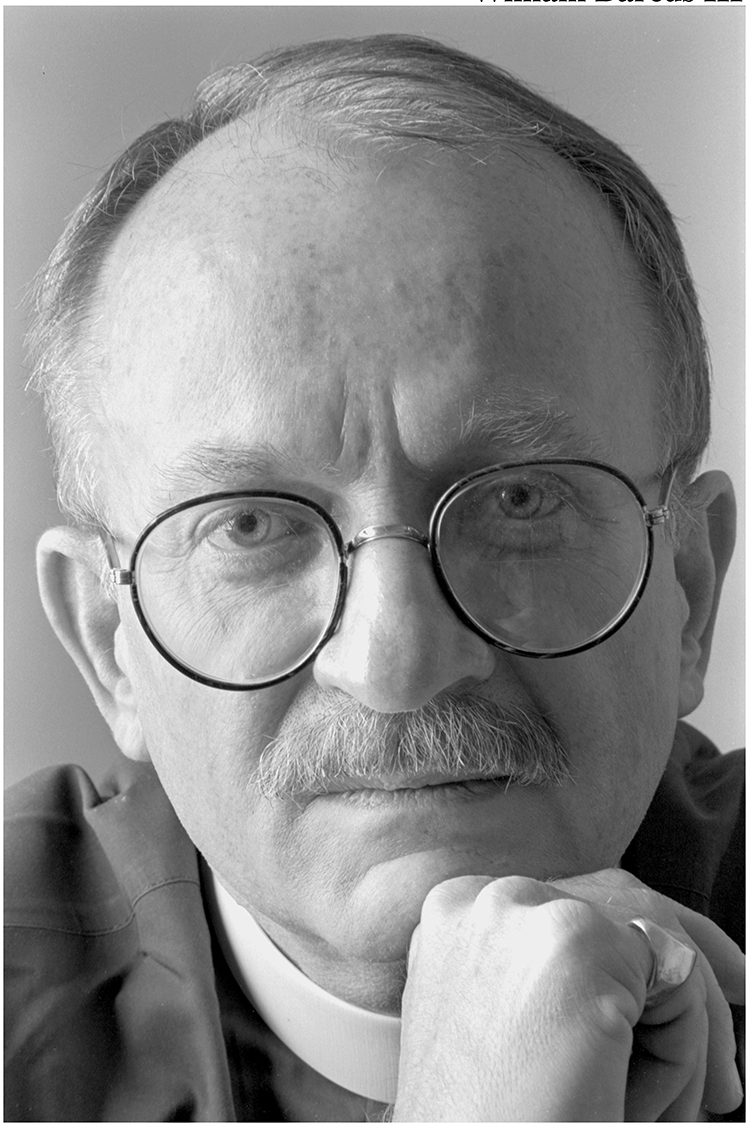
Photo by Jim Wigler for Faces of AIDS exhibition
Rev. Bill Barcus III was born in Wichita Kansas on December 4, 1934. Prior to joining the Episcopal Church as a priest and attending Harvard Divinity School, Barcus had been a flight pilot and attendant. Rev. Barcus first came to prominent national attention in the late 1970s while he led the congregation of Church of the St. Virgin Mary on Union Street in San Francisco. In 1978, as gays and lesbians across California organized to defeat the Briggs Initiative and Anita Bryant’s “Save the Children” campaign, Barcus would come out publicly via his pulpit. Documented in Randy Shilts’ The Mayor of Castro Street: The Life and Times of Harvey Milk and recounted by Harvey Milk himself in an article for the Bay Area Reporter, on October 22, 1978, Barcus gave his Sunday sermon to encourage his congregation to resist the homophobic and hate filled campaign led by Bryant and her followers. Barcus argued against the Briggs Initiative, which sought to legalize the firing of public-school teachers on the basis of their sexual orientation, aka if they were gay or lesbian. In his sermon Barcus declared to his congregation, “I take upon myself the mantle of the outcast…I must stand with my people, gay people.” When Harvey Milk was assassinated by Supervisor Dan White; Barcus spoke alongside the likes of Diane Feinstein and Ann Kroonenberg at a memorial mass at the State theater in San Francisco. In the audience was writer and activist Larry Kramer who wrote that Barcus declared that the audience heed Harvey Milk’s call to come out of the closet. “…..” In the early 1980s, alongside the emerging AIDS crisis also emerged the endless crisis of homelessness in San Francisco and Barcus played an important part in shaping the city’s response to it. In 1983, through funding from the Episcopal Diocese of California, Barcus opened Episcopal Sanctuary in 1983 in the South of Market neighborhood. It quickly grew and was soon providing 200 people shelter at night, particularly the elderly and single women. A notable aspect of the early Episcopal Sanctuary was that Barcus made certain that the homeless would not have their pets turned away, a practice that continues to this day and was unusual for the 1980s. It would expand in the mid 80s and change locations and begin to provide the first ever “day” shelter in San Francisco. But, as his work with the homeless was recognized Barcus’s health began to falter and he was eventually diagnosed with AIDS in 1985. After his diagnosis, Barcus continued his work with the homeless and prioritized AIDS as a matter of importance to not only Episcopalians but theology broadly. He was soon named Canon Rev. Bill Barcus of the church and was the coordinator of Grace Cathedral’s AIDS ministry. He not only supported art and activists connected to AIDS, but took part in it, as was the case when he sat for photographer Jim Wigler’s Faces of AIDS series.
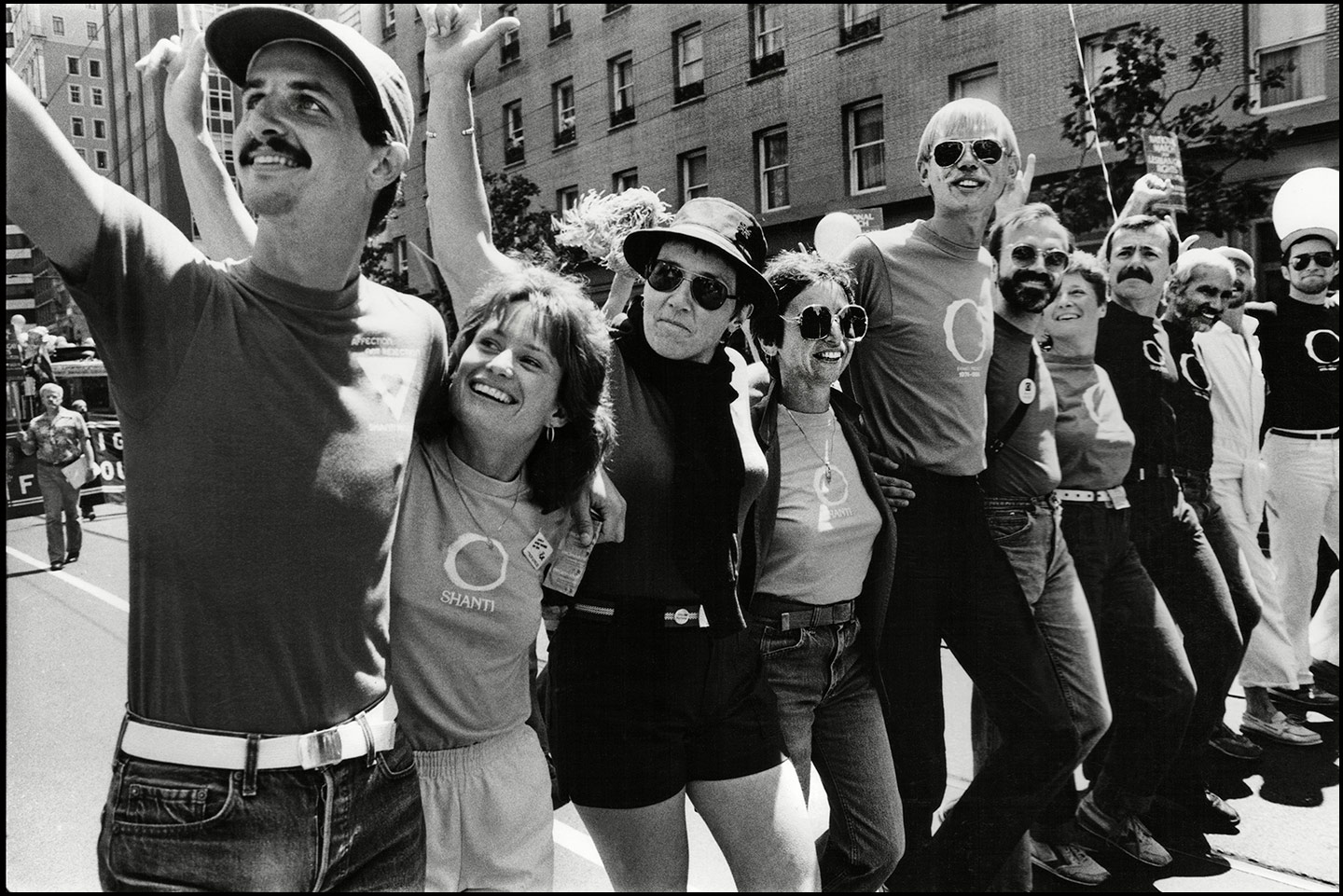
He became involved with Shanti Project first as a client. The following is a portion of a testimonial he shared in an Eclipse newsletter in 1987. On February 4, 1991, Barcus would pass away after a period of illness due to AIDS in his parent’s home in Wichita, Kansas where he was buried. Memorial services were held in San Francisco. He was 56.
“Early on, Shanti was recommended to me. I decided to request an emotional support volunteer. There was one I knew and I asked if he was available. Thank God he was. From that first call to Shanti and subsequently meeting with my AIDS support group, I found people in Shanti helpful and clear and willing to be there…With some very hard work and personal discipline I was able to regain most of my strength…From time to time my system does it’s own battles inside, and when my health goes down, so do my spirits. Shanti is there. My group is there, my support person is there. I’m one of the lucky ones. I discovered that my friends, could not always provide what I was receiving from Shanti. I have had some marvelous friends stay by me through this. Others, whom I still love very much, wanted only distance. I guess all I can do is understand. I am sad for them. Above all others, my Bishop, Bill Swing, has been a prince. Bill has set the standard for caring validating and supporting…You don’t take without giving back. It’s just that simple. I’ve volunteered with Shanti, trained as an emotional support person and been assigned clients who have in every case challenged me and become close friends. I am learning mightily from all this.
I am learning that what some people can’t bring themselves to do is less important than what other good people get done. I have learned that living our lives now with the reality that exists is more important than getting stuck in an irretrievable past.
I have also learned again how beautiful acts of kindness are. And the faces of those who are there. Shanti is peace, peace within resolution. This resolution is supremely important in the long process of saying goodbye which AIDS holds for many of us.
Thank you, Shanti, thank you. You can’t save my life-but you do save my belief in our ability to be there for and with, each other.”

I knew Bill as a fellow Shanti volunteer and facilitator at new volunteer trainings. His humanity and sense of humor never failed.
It was unfortunate that at his funeral at Grace Cathedral Bishop Swing couldn’t return the respect and love that Bill showed to him. Aside from mentioning Bill’s work with the Sanctuary and AIDS ministry, Bishop Swing refused to honor Bill’s out sexuality or Bill’s death from AIDS.